by Melanie Crew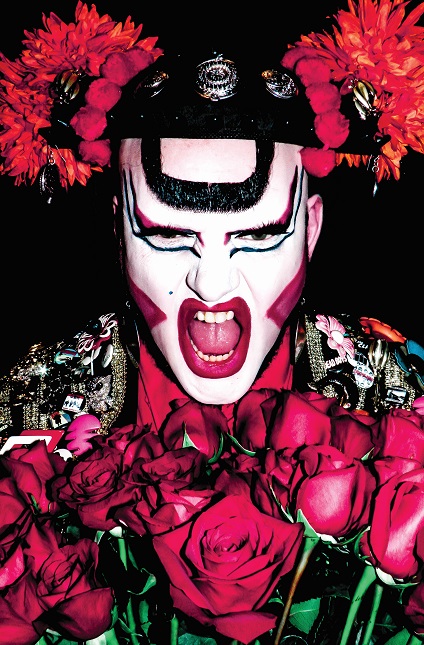
Managing Editor/
Contributing Writer
Get dolled up in your sleaziest glam get-ups because David Richardson, a.k.a. “Baby Doll Schultz” and Kool Kat Chris (Beat) Buxbaum [December 2012; see ATLRetro’s Kool Kat feature on Chris Buxbaum, here] have a phantasmagoric ballyhoo of sizzlin’ sights, sounds and tastes awaiting your deviant little hearts at their “Schizophrenic Photogenic” opening event invading Luckie Street Gallary this Saturday, June 28, from 7 to 11 pm! So, get scandalous and strut your stuff down to the Luckie Street Gallary for a night of mischief and mayhem!
David has been rockin’ the glammed up club scene since the early ‘80s, donning provocative style and inventive transformative creations, birthing the evolution of his stage persona, “Baby Doll Schultz”! In the late ‘80s to mid ‘90s, he was a member of Elaganza, a comedic drag troupe that performed at Atlanta hot spots: the White Dot, Blake’s, Backstreet, the Metro and various other clubs that have since closed. He’s performed with ATLRetro’s sci-fi vaudeville Burly-Q faves, Blast-Off Burlesque, was a member of The Anatomy Theatre, a band that combined electronica with performance art and even had the opportunity to portray his idol, Divine during performances at The Plaza Theatre’s screenings of John Waters’ FEMALE TROUBLE (1974) and PINK FLAMINGOS (1972)!
ATLRetro caught up with David for a quick interview about his love of dramatic costuming, his stimulating past performances, his love of John Waters and his upcoming rockin’ art show, “Schizophrenic Photogenic,” with Chris Buxbaum . And while you’re gettin’ voyeuristic with our little Q&A with David, experience Baby Doll Schultz in action with his former drag comedy troupe, Eleganza at the Metro, performing a parody of Tammy Faye Bakker, here.
ATLRetro: Your taste for the glamorous drag scene erupted in the early ’80s when you began getting dolled up while clubbing and performing at some infamous ATL hot spots, such as the White Dot, Blake’s, Backstreet and the Metro. What drew you to this energetic sub-culture of erotic and phantasmal proportions?
David Richardson: The fantasy and possibility that is inherent in nightlife has always had a lot of appeal for me. You can be anything or anyone you wish to be, if only for one night. You’re not required to be real or politically correct or anything. You can be a different person every night if that is your desire. The donning of makeup and dramatic attire is freeing in the sense that it allows one to play a character and inhibitions are lowered, thus allowing you to be more yourself and more the way you would like yourself to be.
 Having rocked the glam club scene of the early ’80s to the ’90s, would you say the scene has changed? Any nostalgia for the old days? What would you say has improved?
The scene is definitely different now. There aren’t as many large clubs and 24-hour clubs are extinct. The average club-goer doesn’t put as much effort into their look now as back then, when everyone seemingly strived to be a fashion plate. That’s not to say it isn’t vibrant and fun today, because it is! The thing I miss most about the old days is the music; maybe because it was all new to me, but I prefer older music. Somehow it seems more meaningful. What I really dig about clubbing now is the young drag queens. They are really great. The makeup is more extreme, the looks are more fashion forward and they seem totally prepared when they hit the stage. I can’t tell you how many times I stumbled onto a stage, not knowing the words to my song and not having worked out a routine of any kind. Luckily my improvisational skills and the spontaneity of the moment saved me on more than one occasion!
You’ve shared the stage with our sci-fi punk vaudeville pals, Blast-Off Burlesque. What was your favorite performance with them, and why?
My favorite was when we performed BARBARELLA (1968) at Dragon Con 2013 in the Glamour Geek Revue [See performance here]. It was my first time at Dragon Con and I loved it! There was such a sense of wonder and joy at Dragon Con; the dedication to costuming and achieving perfection in a look was completely evident. I got to play the “Great Tyrant”, complete with a golden unicorn horn. I made the costume for that show, which was covered with hundreds of hand-sewn feathers and took a full month to make. I am very proud of that look! I have loved every performance with Blast-Off Burlesque, but our show at Dragon Con 2013 was extra special!
Can you tell our readers a little about your glory days as a drag performer with the troupe, Eleganza?
We (Eleganza) lampooned the ‘70s and ‘80s, with our best shows being thematic. For example, we had a “Fashionquake,” where each member made a mini-collection with two models sporting fashions made of trash and disposable materials. All of our fabulous fashions were destroyed in the finale when an “earthquake” hit the club. We also had a STAR WARS night where all of the numbers were of a sci-fi nature. That night culminated in me wrestling a heckler, who was a collaborating performer planted in the audience, in a kiddie pool full of pork and beans, no less. We also had “The Joey Heatherton Bleach Marathon”, a new-wave night, a show that was a homage to the LOVE BOAT and our “Beautify America” night, where we did makeovers on audience members who we then attacked with cans of shaving cream. The troupe even created a feature length video, directed by David A. Moore, called HAVE YOU SEEN KRYSTLE LITE?, which premiered at Backstreet. The other members of Eleganza were Trina Saxxon, Clive Jackson, Superchic, Krystle Lite, Lurleen and Judy La Grange. We even had Lady Bunny as a special guest one night. Our performances were all pretty irreverent and unpolished, but we had a blast and did it with enthusiasm.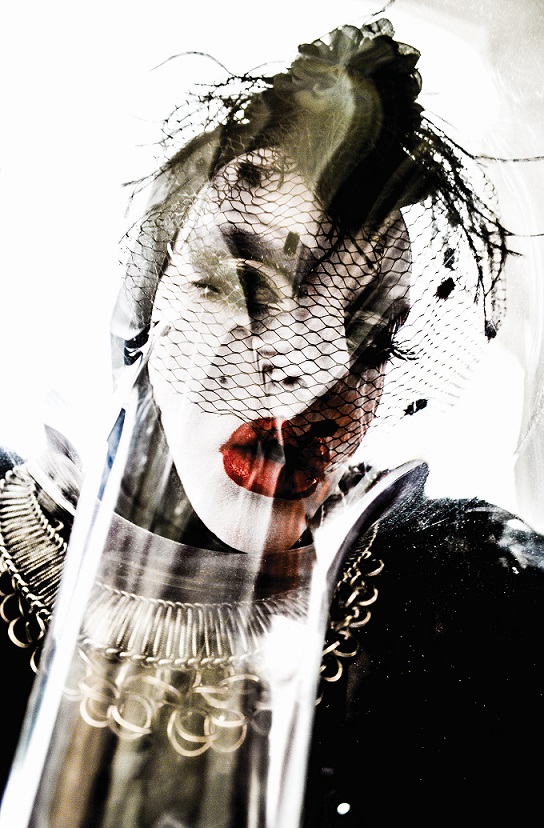
What can you tell our readers about your ’90s band, “The Anatomy Theatre”? And your rock opera play, “The Asylum” that you’d perform at the Masquerade?
The Anatomy Theatre was the brain child of my friend Myron, blending electronic music with performance-art theater. “The Asylum” was an electronic rock opera of sorts set in an insane asylum. Myron was “Dr. Boris” and another friend, Carla, was “Nurse Needles”. They cured the patients by killing them. I played “Harold”, a psychosexual. My cure was electro shock therapy in an electric chair. Stacy, another friend, got a lobotomy with a power drill in the show while our friend Scott was given a scalpel to eviscerate himself. It was replete with gore and black humor. We performed the play three times at the Masquerade. Myron released two self-produced cassettes and performed numerous times, even opening for The Legendary Pink Dots and Frontline Assembly.
You’ve stated that you had the opportunity to play your favorite idol, “Divine”, on a few occasions during The Plaza’s screenings of FEMALE TROUBLE and PINK FLAMINGOS. What about her do you admire? Are there other drag queens you’d like to impersonate?
When I was a kid, I remember reading a review of PINK FLAMINGOS (1972) in the newspaper and it really fascinated me. I didn’t get to see the film until a decade later, on home video, and it got me hooked on John Waters and Divine. What inspires me most about Divine is the absolute fearlessness and ferocity she projected. She also showed me that big girls don’t have to hide in the shadows but can shake it up there with the best of them. I was really honored to play “Dawn Davenport” and “Babs Johnson” with Blast-Off Burlesque. It would be fun to impersonate Lady Bunny because her look is so iconic and recognizable.
You stated that in the late ’90s you withdrew from the rowdy nightlife and became ‘domesticated’. It seems you’re back, and better than ever! What was the catalyst that drew you back into the fabulously raucous flame of female impersonation?
(It was a) Midlife crisis, I guess. I was wondering if my best years were behind me and decided not to withdraw quietly into seclusion. I returned to my passion, dressing up. I believe that my looks now are more accomplished and thoughtful, and I find inspiration everywhere. I even dream of outfits and concepts to hybridize into my collection of characters.
How did you and Chris (Beat) Buxbaum meet? You two seem to have a vibrant artistic relationship; one that screams out in the wicked art you two create. How did you become Chris’ saucy and sinister subject?
I met Chris Buxbaum back in the late 1980s. We had a ton of mutual friends. We didn’t actually start working together until about three years ago when he was photographing the fabulous performe rs of “Sukeban”, a very creative group of individuals performing at My Sisters Room in East Atlanta Village [FENUXE, November 2010]. His photographs at “Sukeban” eventually became his “Transformers” show. From there, he approached me with the “Schizophrenic Photogenic” project and naturally, I was intrigued. It doesn’t hurt that I’m a big old camera hog and a ham! It all seemed so natural and easy.
I also participated in a MODA (Museum of Design Atlanta) event with Chris and Kool Kat Caryn Grossman titled, “The South’s Next Wave: Design Challenge” [December 2012; see ATLRetro’s Kool Kat feature on Chris Buxbaum and Caryn Grossman, here]. During this event, an interior designer was paired with an object-maker and given a color theme to produce a vignette installation. They (Chris and Caryn) were paired with a fabulous cake-maker and given the color blue. The vignette was inspired by Marie Antoinette in a futuristic rococo boudoir setting. Our team went on to win the challenge, which was decided by patron’s votes for their favorite vignette.
What can our readers expect when they come to ‘Schizophrenic Photogenic’ at the LUCKIE STREET GALLERY?
A Happening! A Warhol Factory-style event is the goal of our opening. I’m very pleased and proud of what we have accomplished. The photos are stunning and hopefully each character depicted tells a story. We are encouraging patrons to attend decked out in the most extreme glamour-sleaze looks they can get their hands on. The best look will win a prize!
Do you have anything special planned for ‘Schizophrenic Photogenic’? A little rockin’ hell-raising and deviant shenanigans, maybe? Give our readers a little taste of what mischief and mahhh-velous mayhem they may find themselves mixed up in!
I will be getting into face for the bulk of the opening at a pink satin vanity, adding and layering more and more until my face is completely covered. I plan to be a cross between Liz Taylor in the film BOOM (1968) and Incan Princess Yma Sumac. A silent film, LA BOITE DE BIJOUTERIE, shot by Milford Earl Thomas, will be playing on loop for the duration of the night. There will also be live music performed by Weary Heads, featuring Chris’ son Henry Buxbaum on vocals and bass along with his band mate Andrew Boehnlein. Usually a very feedback noisy band, they are doing a special unplugged set that may include some glamorous and sexy covers. Drinks will be provided by Jennifer Betowt and Deep Eddy Vodka will be featuring four different flavored vodka cocktails!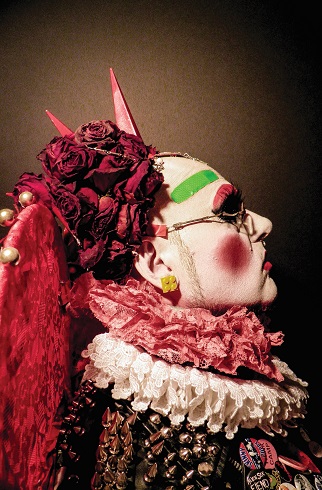
What’s next for Baby Doll Schultz?
I fully expect the world to entertain me with experiences not yet anticipated! Foregoing such, I will create my own experiences, continuing to explore the magic of transformational costuming. There are many upcoming events which I will attend in order to support the creative efforts of others, but, as of now (for me) I am in the hands of vagabond winds and will set sail to whatever destination they take me.
What question do you wish somebody would ask you? And what’s the answer?
I wish someone would ask, “Are you bringing Disco back?” to which I would reply, “I’m bringing sexy back!”, but really, just kidding (I am bringing Disco back)! But seriously, to answer the question, I wish someone would ask me if I enjoy what I do. Too often I get asked where my ideas come from and how I come up with what I do. The answer is innate to who I am, so my looks and outfits come out of my experiences and what I want to portray. And the answer to whether if I enjoy what I do is a resounding, “Yes, yes, yes!”
Can you tell folks something about you that they don’t know already?
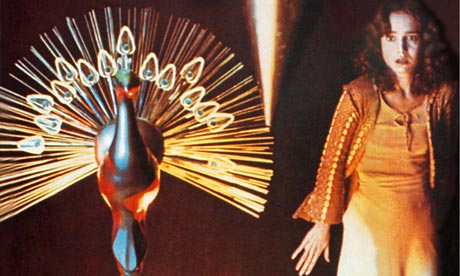
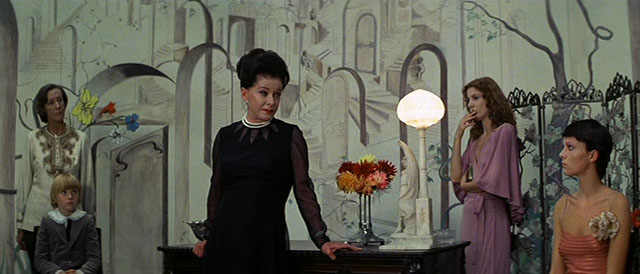
I am a big time movie buff; my favorites are the Italian Giallos of the ‘60s and ‘70s. Anything by Dario Argento of course, and there are also some wonderful offerings from Mario Bava. Any of the Giallos starring Edwige Fenech are stand outs for me!
All photos courtesy of Chris Buxbaum and used with permission.


 THE SUNDAY WOMAN (La Donna Della Domenica) – 1975 Limited Edition
 that refers to the Italian stalking-murderer-wearing-black-gloves style mystery genre of which the early 1970s cineastes were so fond. However, it seems least of all a gialli (the singular) and more an exercise in determinance of how art affects the small slice of society presented as a cross section of Turin, and just how effective art can be as a weapon. Specifically, in this case, the large and heavy terra-cotta phallus sculpture that the killer uses in committing acts of violence.
 Through a combination of humor and grotesquery, Comencini reveals a layered group of characters, all of whom are capable of razor-sharp self-defense in terms of dialog, but vulnerable by emotional damage. The investigation revolves around – wait for it – yet another objet dé art, an artifact of historical importance attached to a local property, which is never truly endowed with enough value to justify the murders. Art then is relegated as the McGuffin, the murder weapon, (perhaps even the murders themselves) and the prevailing currency throughout the narrative. It is valued, de-valued and personified as a character unto itself, maintaining a role greater than any of the film’s stars (or plot).




 Subscribe to ATLRetro
 Join us on Facebook
 Follow us on Twitter