by Melanie Crew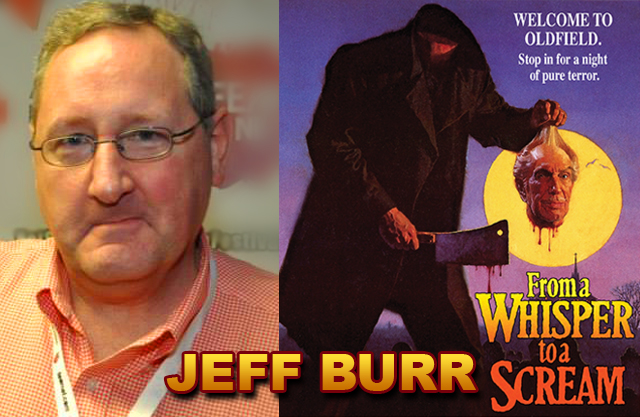
Managing Editor
Jeff Burr, local award-winning independent filmmaker, will be joining a sinister line-up of horrorific guests Monsterama Convention’s fifth frightening year, co-chaired by our classic monster-lovin’ fiend, friend and Kool Kat Anthony Taylor, creeping into the Atlanta Marriott Alpharetta this weekend, Friday – Sunday (Oct. 5-7)! Prepare for a ghastly weekend of ghoulish proportions including a guest list filled to the blood-curdling brim with chillers like Luciana Paluzzi (THUNDERBALL; THE SIX MILLION DOLLAR MAN); Rachel Talalay (FREDDY’S DEAD: THE FINAL NIGHTMARE; TANK GIRL); Ken Sagoes (A NIGHTMARE ON ELM STREET 3); creaturific artist Kool Kat Mark Maddox; Victorian chamber metal musicians Valentine Wolfe; Kool Kat Shane Morton, ghost host with the most, a.k.a. Professor Morte; glamour ghoul Kool Kat Madeline Brumby and so many more! So why not get wicked and haunt on down to MONSTERAMA for a weekend of monster madness!
Burr’s film career spans 30+ years as writer, director, producer and actor. His love of filmmaking spawned as a child growing up in Dalton, GA, with the production of Super 8 films with his neighborhood friends, and became  full-on reality when he was a student at the University of Southern California. He and classmate Kevin Meyer produced their student film, a Civil War drama, DIVIDED WE FALL in 1982, which gained a lot of attention from film festival goers and jurors, taking home over a dozen awards world-wide. His first feature film, horror anthology FROM A WHISPER TO A SCREAM released in 1987 under the title THE OFFSPRING, starring the Godfather of Horror, Vincent Price, alongside a strong cast of actors and actresses. On April 28, 2015, Shout Factory released their Blu-ray of WHISPER, containing bonus features produced by local horror history expert and documentarian, Kool Kat Daniel Griffith of Ballyhoo Motion Pictures [RETURN TO OLDFIELD, and A DECADE UNDER THE INNOCENCE]. Burr continued to delve deep into the abyss of horror as the director of STEPFATHER II (1989), LEATHERFACE: TEXAS CHAINSAW MASSACRE III (1990), PUPPET MASTER 4 (1993), PUPPET MASTER 5 (1994), PUMPKINHEAD II (1993) and he will continue to play in the filmmaker fire as long as he is able!
ATLRetro caught up with Jeff Burr for a quick interview about his love of film; his first ever feature-length film, FROM A WHISPER TO A SCREAM; his experiences with the one-and-only Vincent Price and this year’s maniacal MONSTERAMA madness!
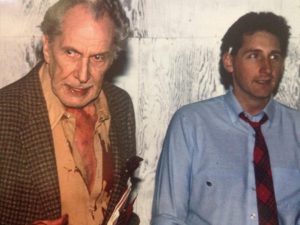
From A Whisper to a Scream Set – Vincent Price, Jeff Burr
ATLRetro: As a visual storyteller and filmmaker, you’ve played the roles of director, writer, producer and actor for the last 30-plus years. What drew you to become a filmmaker and what keeps you playing the game?
Jeff Burr: I grew up in Dalton, GA and for whatever reason always loved movies. My mom worked for a radio station and had a pass from the local theaters to see any movie for 50 cents, so I saw quite a few movies from a young age. Both of my parents were active in community theater in Dalton, and I always loved going backstage, etc. to see how the sets were built and behind the scenes. I started making Super 8 films with my friends and it grew from there. It is a calling, or an obsession, or an addiction…pick your label. It is one of the most frustrating, heartbreaking, crazy endeavors to make a film – the only thing worse is not doing it! If you will permit a shameless plug, on the Scream Factory Blu-ray of my first feature film FROM A WHISPER TO A SCREAM, there is a documentary by Daniel Griffith called A DECADE UNDER THE INNOCENCE, and that is truly my origin story.
Is there a film you have always wanted to make? Or still plan to make?
Heck yes! I have several films that I want to make. One is a comedy/drama, another is a period adventure film in the vein of THE MAN WHO WOULD BE KING, albeit lower-budget and messy, not unlike AGUIRRE in scale. I am also working with a talented writer from Florida, Jonathan Dornellas, on a horror script about a subject that affects everyone.
 You co-directed your final student film for USC, DIVIDED WE FALL (1982), with Kevin Meyer, winning over a dozen awards at film festivals world-wide. Can you tell us a little about the film, and what it felt like to win so many awards as a student filmmaker? And most importantly, how can our readers access the film, if possible?
DIVIDED WE FALL was a period Civil War action/drama that kind of became our own version of APOCALYPSE NOW. The film grew and grew in scale and took close to a year to make. John Agar (a name Monsterama fans would hopefully know and love), Nicholas Guest and David Cloud starred. Future “Leatherface,” R.A. Mihailoff and veteran character actor Mike Shamus Wiles had major supporting parts. Kevin Meyer and I did everything on it – writing, directing, photographing, editing, producing, etc. We dropped out of school to finish it and had a big premiere in November of 1982. The film went on to win awards, etc., but the gates of the Hollywood Studios didn’t magically open for us, as we probably naively thought! I am hoping the film will be included on the upcoming Turbine (germany) release of FROM A WHISPER TO A SCREAM.
Your first feature film and horror anthology, FROM A WHISPER TO A SCREAM (1987) [a.k.a. THE OFFSPRING], which was shot mostly in Dalton, Georgia, just a few short hours north, became a huge cult hit amongst genre lovers. Any fun/scandalous behind-the-scenes stories you’d like to share with our readers?
The making of FROM A WHISPER TO A SCREAM is full of stories, and if you’ll permit me one more shameless plug I would suggest that if you have any interest in the making of a very low-budget regional film in the 1980s there is an amazing documentary on the Scream Factory Blu-ray from Daniel Griffith and Ballyhoo Productions entitled RETURN TO OLDFIELD. WHISPER was my first feature film, and in many ways it felt like an extension of my Super 8 films. I was happy and lucky to have my brother William as one of the producers, and my great and talented friend from college Darin Scott as the other producer and co-writer – not to mention another great college friend C. Courtney Joyner as the other co-writer. The crew was a mix of amateur and professional, and it was an amazing experience. The cast was a dream come true, and getting to work with actors such as Vincent Price, Clu Gulager, Cameron Mitchell, Terry Kiser, Harry Caesar, Rosalind Cash, Angelo Rossitto, Susan Tyrrell and Martine Beswicke was pure artistic bliss. As far as scandalous stories go, you’ll have to see the documentary and hear the commentaries!
Speaking of WHISPER, in your opinion, what are the pros and cons of directing an independent “regional” film vs. a Hollywood studio production?
Well the obvious “con” about doing a regional low-budget film is that you don’t have money to throw at problems that invariably rise up, but the good thing is that you can solve those problems with imagination. It might lead down a different and better path. What was wonderful about making the film was that I had complete creative control, and didn’t have to justify every artistic decision to some producer or executive. I am an independent filmmaker at heart, and that is where I belong. It has only taken me 30+ years to figure out what I knew at age 17! And for the record, I really have never directed a real “studio” film. I would say I made it to the triple A ballpark but never really took a swing in the major leagues.
What were the advantages of revisiting the neighborhood backlot of your childhood?
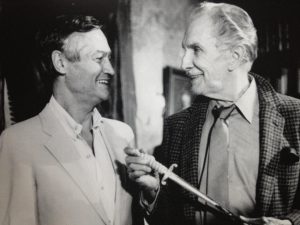
Whisper – Roger Corman and Vincent Price unite!
The advantage of shooting a film in Dalton was that I knew some pretty interesting locations and was able to shoot them, and the town itself was incredibly cooperative and enthusiastic. No film had ever been shot there, and of course the process of making a film was very different then. Now there are films made in every small town in America! But Dalton really was a supporting character in the movie, and it could not have been made anywhere else. In a very literal sense, I owe whatever career I have and had to the town of Dalton.
What was it like to work with the “Merchant of Menace,” Vincent Price, a.k.a. Julian White, the historian and thread that tied the terrifying tales together in WHISPER?
Working with Vincent was heaven. Getting Vincent to do the movie was hell. He was just as you would probably expect – generous, funny, so intelligent, warm, and so damn talented. It was an honor, and I do mean an honor, to be able to direct him. But in the process of getting him to do the movie, man oh man there were a few moments I will never forget. Watch the documentary! (And come talk to me at Monsterama – I will tell the whole story!)
In true Price fashion, his character says, “One thing I’ve learned, my dear, is that one is never too old for nightmares.” As a purveyor of horror [TEXAS CHAINSAW MASSACRE III; PUPPET MASTER 4 & 5; PUMPKINHEAD II, etc.], would you agree with this statement? Can one be too old for spooky, nightmarish fun?
No one is ever too old for nightmares. What makes you have nightmares might change, but there will always be delicious dread certain nights when you lay your head on your pillow. And one thing that horror fans (of which I am proud to be one) have is a sense of wonder and humor that keeps you young. I don’t like the phrase “They never grow up.” Better, “They never grow old!” To have a sense of wonder about the world, and an amusement, or bemusement, even of the worst of the world is a great quality to possess.
Do you think you’ll ever return to Dalton to make another feature film?
LET US PREY (early Super 8 film starring Bobby Pike)
I absolutely intend on making more films in Dalton! There is an amazing talent pool in North Georgia, one that is growing as I type this! And the filmmaking infrastructure in GA is here to stay. GODZILLA, KING OF MONSTERS shot for one day in Dalton. I would have fainted if that had happened when I was 14!
Who would you say are the filmmakers or films that inspired you the most and what was it about those particular filmmakers/films that inspired you?
I have been inspired by many films and filmmakers. In the horror genre, David Cronenberg, George Romero, John Carpenter, James Whale, Michael Reeves, Roger Corman – way too many to mention! Certain fairly obscure films that I saw as a kid and always stuck with me are PHASE IV, EQUINOX, SHOCK WAVES, THE TERRORNAUTS. However, I would say the most influential movie that I have seen is 2001: A SPACE ODYSSEY. I saw it as a kid, and I have seen it many, many times since on the big screen. Just saw it twice in the 50 year anniversary edition. I don’t know why that film hooked onto me, but it did and it has stayed with me for 50 years. Other directors/films I love are Jerry Lewis, William Friedkin, Orson Welles, Sam Peckinpah, Stanley Kubrick, Andrei Tarkovsky – again too many to mention. To be a filmmaker, you have to be a lover of film, of all film, from all countries.
Can you tell us a little about working for the king of B-films, Roger Corman, at New World Pictures?
I worked in the advertising department with Jim Wynorski, and it was as crazy and as educational as you could imagine. My crowning glory was that my tagline was used for the newspaper ads for SLUMBER PARTY MASSACRE – “He’s dressed to drill!” And a few years later, I had a meeting with Roger about directing Vincent Price, and he came to the set to have a reunion with Vincent!
 Would you agree that independent filmmakers have come to rely on the popularization of smaller and more local film festivals, especially genre filmmakers? Why do you feel that film festivals are so important to independent filmmakers?
Film festivals are essential to low-budget indie filmmakers, as it can be the only theatrical exposure that they have. To see a film with an audience and to hear the reactions is uplifting and incredibly educational for filmmakers. And it is a way to break through the white noise of so many films out there, with word of mouth, reviews, etc. I hope that the theatrical experience for smaller films doesn’t go away!
Can you give us five things you’re into at the moment that we should be watching, reading or listening to right now— past or present, well-known or obscure?
The 50th anniversary reissue of 2001: A SPACE ODYSSEY; the reissue of SMOKEY AND THE BANDIT in Burt’s memory; waiting for Don Coscarelli‘s book on independent filmmaking, TREE OF LIFE Criterion Blu-ray; and waiting for the (soon to be released) TALES FROM THE HOOD 2 from my good pals Darin Scott and Rusty Cundieff!
Any advice for up and coming filmmakers out there trying to get their foot in the door?
The most obvious piece of advice for aspiring filmmakers is get out there and make a film. Make one, learn from it, apply the lessons to the next one, and on and on in a never-ending cycle. Two more things – don’t be more excited about the gear you have to make the film than the story you are telling. Love your actors and cast very, very carefully. A wrong casting decision cannot be fixed in post. In the scripting, shooting, and post processes, take your time so you don’t waste the audience’s. And as quickly as you can, learn that the most important thing to photograph is the human face.
What’s next for Jeff Burr? Anything exciting coming down the pike?
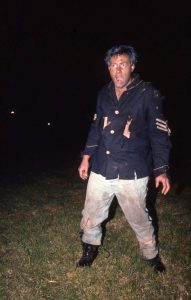
William Burr doubles as Cameron Mitchell (Whisper)
There’s always something exciting coming down the pike! I’ve got projects I am working on, and who knows what lurks down an unknown road?
And last but not least, what are you looking forward to most at MONSTERAMA, one of our favorite local classic monster conventions around!? Anything exciting planned for attendees?
I think I will be on a panel, and there will be full disclosure about any area of my checkered career that anyone wants to know about. I am just looking forward to talking to people that have the same love of movies that I do, and I always learn of films that fell under my radar that I will then seek out, etc. I look forward to seeing Sam Irvin again – he is a great guy and a talented and dedicated filmmaker. And of course to meet Mark Goddard, Luciana Paluzzi, etc. Meeting and talking to actors you have admired since childhood is a great thrill. And I have some THE KLANSMAN questions for Luciana!!!
All photos courtesy of Jeff Burr and used with permission.


 NIGHT OF THE ANIMATED DEAD – 2021
 a whole bunch of unnecessary and egregious horror remakes. This is a – wait for it – animated remake of NIGHT OF THE LIVING DEAD (1968), with more gore and a few added sequences. At first I thought it might just be a copyright grab, since George A. Romero’s original film was released sans copyright notice and fell immediately into the public domain. But changing the name from “Living” to “Animated” eliminates any benefit of a new copyright for merchandising or marketing purposes.
 The film misfires at every turn with almost nothing to recommend about it at all. It lacks the urgency and panache of the original. The voice cast does include some wonderful actors – Dulé Hill, Nancy Travis, Will Sasso, and even Josh Duhamel gives a good performance. It’s unfortunate the talent was wasted on such a bizarre and dreadful project.










 Subscribe to ATLRetro
 Join us on Facebook
 Follow us on Twitter